
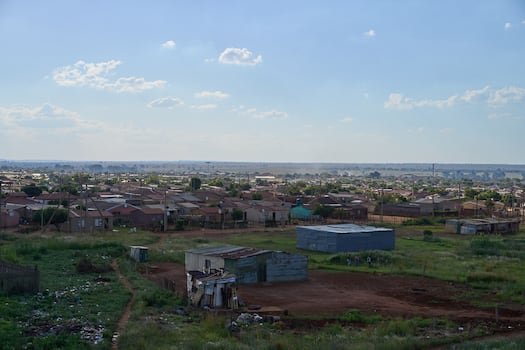
Thabo Molelekwa explores the rising challenge of energy poverty driven by prepaid electricity meters prevalent in numerous municipalities.
In the Merafong local municipality, situated in Gauteng’s West Rand, many homes remain physically connected to the national electricity grid but face severe affordability barriers. This situation highlights how prepaid electricity systems, municipal financial woes, and governance shortcomings are collectively deepening energy poverty in these communities.
Despite visible infrastructure such as overhead power lines and installed meters, many households experience frequent power outages. Oxpeckers’ recent field observations revealed that the issue is no longer about access to electricity but the ability to afford its consumption.
Within Carletonville and Khutsong-areas historically shaped by gold mining-residents report enduring extended blackouts once their free basic electricity quotas and prepaid units are depleted. Although still linked to the grid, electricity usage becomes intermittent or ceases altogether, a phenomenon experts and advocacy groups term “self-disconnection.”
For numerous families, escalating electricity costs combined with prepaid metering have relegated municipal power to a secondary, unreliable energy source, only utilized when finances permit. This trend emerged consistently during interviews conducted by Oxpeckers in the region.
Financial Pressures on the Municipality
Merafong municipality is grappling with a severe fiscal crisis that exacerbates the energy predicament.
Data from Eskom indicates that since 2015, Merafong has accumulated approximately R1.8 billion in unpaid electricity bills, ranking it among the highest municipal debtors to Eskom nationwide.
Eskom clarifies that municipalities are responsible for customer billing and revenue collection within their licensed supply zones, including managing prepaid metering systems. When municipalities default on payments for bulk electricity, the repercussions ripple beyond their own budgets, impacting the entire electricity supply chain.

Municipalities also influence how households transition from grid electricity by setting tariffs, managing prepaid systems, administering indigent support, and regulating alternative energy options like rooftop solar installations.
“When municipalities fail to pay Eskom, it strains the entire electricity value chain, hindering Eskom’s capacity to invest in infrastructure, maintain networks, and guarantee consistent supply,” Eskom’s media office explained.
The utility recognizes that paying customers often bear the brunt of municipal financial failures.
“Eskom understands the frustration of residents who fulfill their payment obligations but suffer due to municipal non-payment,” the utility stated. “Billing and revenue collection remain the responsibility of municipalities within their licensed areas, including prepaid environments.”
Eskom’s Intervention to Stabilize Revenue
To address Merafong’s growing debt, Eskom has implemented a distribution agency agreement with the municipality. This arrangement transfers electricity billing and revenue collection responsibilities directly to Eskom, allowing customers to pay the utility for electricity while the municipality retains its distribution license.
Eskom describes this measure as a way to stabilize revenue streams and safeguard the electricity supply chain. The billing and collection processes are “ring-fenced” and managed through Eskom’s systems.
The agreement does not alter the administration of free basic electricity (FBE), which grants qualifying low-income households 50 kilowatt-hours of electricity monthly at no charge.
“There will be no changes to how free basic electricity is managed, ensuring indigent households remain unaffected by this agreement,” Eskom confirmed.
The Impact of Prepaid Electricity Systems
Prepaid electricity meters dominate household energy supply in Merafong and many other municipalities. These systems require consumers to purchase electricity credits in advance before usage.
While prepaid meters help utilities and municipalities reduce debt and secure revenue, they transfer financial risk directly onto households with limited incomes.
The Organisation Undoing Tax Abuse (Outa), a civil rights watchdog, identifies this risk transfer as central to the affordability crisis.
“Prepaid electricity shifts financial risk away from municipalities and utilities, placing it squarely on households,” an Outa representative explained.
“Even residents who pay their bills face rising costs, deteriorating service quality, and growing insecurity, while systemic governance failures remain unresolved.”
“For low-income families, this often leads to ‘self-disconnection’-not due to lack of electricity availability but because they cannot afford to keep the power on. Once funds run out, electricity usage stops.”
The spokesperson added that municipal arrears to Eskom exacerbate the problem.
“When municipalities fall behind on Eskom payments, the burden often shifts downstream to consumers through higher tariffs, stricter enforcement, aggressive prepaid rollouts, and reduced consumer flexibility.”
Outa further noted that even paying households effectively subsidize municipal financial mismanagement.
“Compliant residents bear the cost of rising prices and declining service, while governance issues remain unaddressed,” the spokesperson said.
Limitations of Free Basic Electricity
Free basic electricity (FBE) aims to shield indigent households by providing a monthly allocation of 50 kilowatt-hours at no cost. However, its effectiveness in preventing energy exclusion is limited.
Outa highlights that FBE implementation is inconsistent and often inadequate, especially in municipalities heavily dependent on prepaid revenue.
“Although well-intentioned, the FBE allocation is usually insufficient to cover basic household energy needs, particularly as electricity prices continue to climb,” the organization stated.
“In prepaid-dependent areas, FBE credits can be irregular, poorly communicated, or lost due to administrative errors.”
“For many families, FBE delays but does not prevent energy exclusion.”
Electricity Pricing and Regulatory Oversight
While municipalities and Eskom manage electricity distribution, the ultimate prices paid by consumers are influenced by tariff decisions approved by the National Energy Regulator of South Africa (Nersa).
Charles Hlebela, Nersa’s communications head, explained that the regulator’s role is to review and approve tariff proposals submitted annually by municipalities under the Electricity Regulation Act.
“We assess whether proposed tariffs are cost-reflective, reasonable, and comply with regulatory frameworks and cost-of-supply principles,” Hlebela said.

Hlebela noted that Nersa incorporates considerations for low-income consumers through mechanisms such as FBE, lifeline tariffs, cross-subsidization, and public consultations.
“Our mandate is to balance financial sustainability with consumer protection within legislative boundaries,” he added.
However, Nersa’s oversight does not extend to monitoring electricity consumption at the household level. Instead, it relies on aggregated data submitted by municipalities and utilities.
“While these inputs guide our assessments, they do not provide a detailed view of individual household electricity usage,” Hlebela explained.
Additionally, municipal debt is not a direct factor in tariff approvals, which focus on efficiency, affordability, and regulatory compliance rather than debt recovery alone.
Responsibility for identifying eligible households and managing FBE primarily rests with municipalities and national government.
Living Without Reliable Electricity
Tebogo Koboyankwe, a Khutsong South community member, shared how unaffordable electricity tariffs and dysfunctional municipal systems have forced many families to resort to unsafe and informal coping strategies.
“The main issue here is the high cost of electricity,” Koboyankwe said. “People simply cannot afford to pay.”
He recounted that residents initially accepted prepaid electricity systems when payments directly translated into power supply. However, about ten years ago, the municipality began reallocating prepaid payments across multiple services, including water.
“At first, if you bought electricity, you got electricity,” he explained. “Then the municipality started splitting payments-first 50-50, then 60-40, and eventually 70-30, with 70% going to water and only 30% to electricity.”
This shift left households paying for services they could neither monitor nor afford, prompting widespread refusal to pay and the emergence of electricity bypassing.
“People aren’t bypassing meters to get free electricity-they do it because they are unemployed and electricity is too costly,” Koboyankwe emphasized.

Koboyankwe also noted that even households that initially complied with payments eventually succumbed to non-payment pressures.
“My mother was the only one paying for electricity on our street, but the cost became unbearable. Neighbors told her, ‘You’re the only one paying while we’re bypassing.’ Eventually, she stopped paying too.”
He added that many residents remain unaware of their entitlement to free basic electricity and water services.
“The municipality isn’t transparent. People don’t know they qualify for these basic services,” he said.
Renewable Energy Initiatives and Community Inclusion
Merafong is home to an 800MW solar photovoltaic park currently under development through a public-private partnership with the Gauteng provincial government. This project aims to enhance energy security and reduce dependence on Eskom.
However, Koboyankwe lamented the lack of community engagement regarding the solar park.
“People here have no information about the project. There’s no awareness,” he said.
Outa cautions that large-scale renewable energy projects risk excluding local households if benefits are not deliberately shared.
“Renewable energy developments must deliver tangible advantages to nearby communities, not just feed power into the national grid,” Outa’s spokesperson warned. “Without targeted measures to improve affordability and access, these projects may perpetuate existing inequalities.”
Health Risks from Energy Insecurity
When electricity is unaffordable, households often resort to hazardous alternatives with serious health implications.
“We use an open-flame stove, which is very dangerous,” said Khutsong resident Julia Kolodi. “The smoke lingers in the house, and I developed tuberculosis because of it. Gas is also too expensive. We have electricity but can’t use it.”
“We held meetings with the councillor who promised to resolve electricity issues. Later, we learned the municipality owes Eskom a huge debt. People in town and the mines are paying, so where is that money going?”
Daphney Letswamotsi, another Khutsong resident, shared that despite repeated appeals to local councillors, electricity challenges persist.
“Electricity prices have forced many to bypass meters,” she said. “When you buy electricity for R20, you get only five units, which is barely enough. That’s why people resort to bypassing.”
Living on a child support grant, she expressed the difficulty of coping with the situation.
“I can’t afford paraffin for the stove either,” Letswamotsi said. “I’m struggling.”
Municipal Accountability and Transparency
Oxpeckers reached out to Merafong local municipality on February 5 with detailed questions about electricity affordability, prepaid systems, FBE, municipal debt to Eskom, and the Merafong Solar Park. The municipality’s communications manager, Thabo Moloja, confirmed receipt during a phone conversation.
Despite multiple follow-ups, including a final reminder on February 18, no official response was received by the time of publication. Oxpeckers will provide updates if the municipality replies.
• This investigation by the Oxpeckers #PowerTracker project was supported by the New Economy Hub and Ford Foundation.